
Personal Finance Guides for India
Start with one of seven focused hubs for budgeting, loans, income tax, salary, savings, investing, or government compliance—then move directly to the calculator that supports the decision.
Explore by financial goal
Seven clear topic hubs replace overlapping tags and make the next useful guide easier to find.

✦ Featured
Savings & Retirement10 min read
EPF vs NPS vs PPF — Which Retirement Instrument Should You Prioritise in India?
EPF, NPS and PPF are often grouped together because all three can support long-term savings, but they solve different problems. EPF is linked to eligible employment, NPS Tier I is a retirement account with market-linked investments and regulated exit rules, and PPF is a government-backed small-savings account with a long base tenure. The useful question is not which product is universally best; it is which role each one should play in your own retirement plan.
August 2026Read Article →

Loans & Debt9 min read
Best Credit Cards for Cashback vs Rewards? How to Actually Compare Them in India
A card promising 5% cashback and another promising 10 reward points per ₹100 cannot be compared by looking at those two numbers. The real comparison is the rupee value you receive on the spend you actually make after category caps, excluded transactions, annual fees, redemption ratios and any interest you pay. This guide is about the comparison method, not a ranking of issuers.
August 2026Read Article →

Salary & Benefits9 min read
How to Negotiate a Salary Hike — What to Ask for Beyond Base Pay in India
A salary negotiation is not only a percentage increase on CTC. Two offers with the same CTC can produce very different monthly cash flow, guaranteed pay and long-term value once variable pay, joining bonus, retention conditions, provident-fund structure, insurance, leave, role scope and location costs are considered. The best preparation is to compare the entire package before you name a number.
August 2026Read Article →

Investing10 min read
Robo-Advisors vs DIY Index Investing in India — Costs and Trade-offs
Robo-advisory and DIY index investing can use similar low-cost funds yet produce different total costs and user experiences. A robo service may add portfolio construction, rebalancing, goal tracking and behavioural prompts; DIY investing removes that service layer but places every decision and operational task on the investor. The right comparison is not “active versus passive”; it is service value versus extra cost and responsibility.
August 2026Read Article →

Investing10 min read
Gold as an Asset Class in 2026 — SGB, Gold ETF, Physical Gold and Gold Loan Compared
“Gold” can mean very different financial positions. Physical jewellery has making charges and storage considerations. Gold ETFs provide market-linked exposure through a fund structure. Existing Sovereign Gold Bonds have their own coupon, maturity and redemption rules. A gold loan is not an investment at all: it is borrowing secured by gold you already own. Comparing them requires separating investment exposure from liquidity and borrowing needs.
August 2026Read Article →

Budgeting & Money Planning12 min read
FY 2026-27 Money Moves — A Mid-Year Checklist for Salaried Indians
A financial year is easier to manage when you review it before March. August is still early enough to correct salary assumptions, tax planning, insurance gaps, expensive debt, investment costs and large upcoming goals without turning the last few weeks of the year into a rush. This page is a hub for the calculators and guides RupeeKit shipped during the 3–9 August sprint.
August 2026Read Article →
Income Tax11 min read
Presumptive Taxation under Section 44ADA for Freelancers in India
Many freelancers hear that they can simply declare half of their receipts as taxable professional income. That idea comes from the presumptive taxation scheme commonly known as Section 44ADA. It can reduce bookkeeping work, but it is not available to every freelancer and it is not automatically the lowest-tax option. From 1 April 2026, the Income Tax Act, 2025 places the corresponding presumptive rules in Section 58, while taxpayers still commonly search for the familiar name Section 44ADA.
August 2026Read Article →
Income Tax10 min read
TDS on Fixed Deposit Interest: Thresholds, Form 15G/15H and Refunds
A bank deducting TDS from fixed-deposit interest does not mean that the interest has become tax-free or that the bank has calculated your final tax. TDS is only an advance collection. For Tax Year 2026-27, the rates and monetary thresholds are retained under the Income Tax Act, 2025, while the familiar Form 15G and Form 15H process moves into the new Form 121 framework.
August 2026Read Article →
Income Tax12 min read
ITR Late Filing Penalty and Interest: Sections 234F, 234A, 234B and 234C
Missing an income-tax return deadline can create more than one charge. The late-filing fee is separate from interest on unpaid self-assessment tax and separate again from advance-tax shortfall interest. For FY 2026-27, the Income Tax Act, 2025 uses new section numbers, but taxpayers will continue to see the familiar descriptions Section 234F, 234A, 234B and 234C in older guides and past-year filings.
August 2026Read Article →
Government & Compliance13 min read
GST for Small Businesses and Freelancers: Registration, Composition and ITC
GST registration is not decided only by whether one invoice crosses a limit. You need to identify whether you supply goods, services or both, calculate PAN-based aggregate turnover across India, check your State or Union Territory and review compulsory-registration rules. The composition scheme can simplify payment for eligible small taxpayers, but it also removes input tax credit and the right to collect GST separately.
August 2026Read Article →
Income Tax13 min read
NRI Taxation Basics: Residency Status and Income Taxable in India
NRI tax starts with residential status, not citizenship, passport colour or the type of bank account you hold. A person can be an Indian citizen and still be non-resident for tax, or can become resident after spending enough days in India. From Tax Year 2026-27, the Income Tax Act, 2025 retains the core 182-day, 120-day, deemed-resident and RNOR rules.
August 2026Read Article →
Investing11 min read
How Capital Gains Tax Changed and What It Means for Equity Investors
The major equity capital-gains rate change did not begin on 1 April 2026. It began for transfers on or after 23 July 2024 and continues to shape investor tax in 2026: specified equity short-term gains are taxed at 20%, while long-term gains are taxed at 12.5% above the annual Rs 1.25 lakh threshold. The Income Tax Act, 2025 changes the legal structure and terminology from Tax Year 2026-27, but investors should not mistake renumbering for a fresh rate reset.
August 2026Read Article →
Government & Compliance14 min read
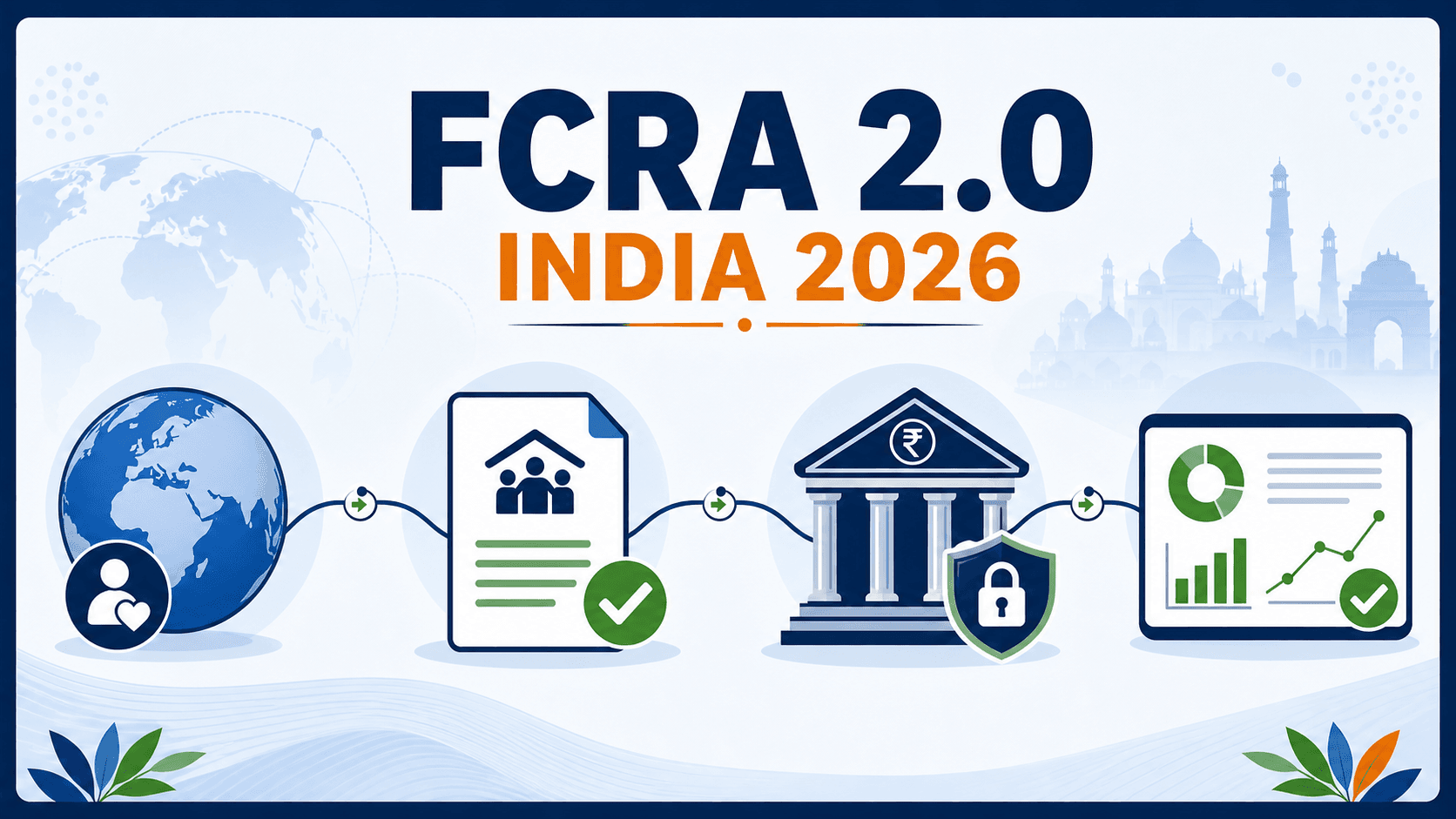
FCRA 2.0 India 2026: New Rules, Portal and Bill Explained in Simple English
FCRA 2.0 is the name commonly being used for India’s upgraded foreign-contribution compliance system. It is not a completely new Act. It combines the existing Foreign Contribution (Regulation) Act, the Foreign Contribution (Regulation) Amendment Rules, 2026, the new digital FCRA 2.0 portal, and a separate Amendment Bill that is still pending in Parliament. This guide explains what is already law, what is only proposed, and what organisations should do next.
August 2026Read Article →
Budgeting & Money Planning6 min read
How to Create a Monthly Budget: A Step-by-Step Guide for Beginners
Budgeting is not about restricting your freedom; it is about giving your money a job. Creating a monthly budget is the single most effective way to understand where your hard-earned money is going and to ensure that you are saving enough for your future goals. In this guide, we will break down the process of creating a realistic budget that you can actually stick to.
May 2026Read Article →
Budgeting & Money Planning5 min read
The 50/30/20 Budget Rule: How to Allocate Your Income in India
If you find budgeting tools complicated or hate tracking every single rupee, the 50/30/20 rule is for you. Popularized by Senator Elizabeth Warren in her book "All Your Worth", this rule provides a simple percentage-based guide to manage your take-home income without stress.
May 2026Read Article →
Savings & Retirement6 min read
How Much Emergency Fund Do You Need? A Guide for Indian Households
Life is full of unexpected events: a sudden medical emergency, temporary job loss, urgent car repairs, or home maintenance. An emergency fund is a pool of cash set aside strictly for these unplanned events. It acts as a financial shock absorber, protecting you from high-interest debt when crises arise.
May 2026Read Article →
Budgeting & Money Planning7 min read
5 Best Personal Finance Books for Beginners (India Edition)
Reading is one of the most cost-effective ways to gain financial literacy. The right book can completely change how you view saving, investing, debt, and wealth. In this curated list, we share the top personal finance books that are perfect for beginners looking to build strong money habits.
May 2026Read Article →
Budgeting & Money Planning5 min read
How to Track Expenses: The Key to Taking Control of Your Money
You cannot manage what you do not measure. Many people wonder why they have no money left at the end of the month despite earning a good salary. The answer usually lies in "spending leaks"—small, unchecked variable expenses that accumulate silently. Tracking your expenses is the first step to financial control.
May 2026Read Article →
Investing6 min read
Saving vs Investing: Key Differences and When to Use Which
While saving and investing are often used interchangeably, they represent two completely different strategies for managing money. Understanding when to save and when to invest is crucial for protecting your cash from inflation and achieving your long-term goals.
May 2026Read Article →
Budgeting & Money Planning6 min read
Monthly Expense Planning for Indian Families: A Practical Guide
Managing expenses for a single person is simple, but planning for a household with a spouse, children, and dependent parents requires a structured system. Conflicting financial goals, seasonal school fees, and medical bills can easily derail your finances. This guide provides a step-by-step framework to plan family expenses smoothly.
May 2026Read Article →
Loans & Debt6 min read
Debt Repayment Planning: Snowball vs. Avalanche Methods
Carrying high-interest debt is like walking against a strong wind. Credit card bills, personal loans, and consumer EMIs consume your income, leaving you with little to save or invest. Building a structured debt repayment plan is critical for reclaiming your financial freedom. Let's look at how to get out of debt systematically.
May 2026Read Article →
Budgeting & Money Planning5 min read
How to Build Better Money Habits: A Guide to Financial Discipline
Personal finance is 80% behavior and only 20% knowledge. Most people know they should save and invest, but struggle to do so consistently due to bad financial habits. Building better money habits is the secret to achieving long-term financial security and peace of mind.
May 2026Read Article →
Budgeting & Money Planning7 min read
Personal Finance Checklist for Salaried People in India
As a salaried professional in India, you have a predictable income, but you also face structured tax deductions. Navigating EPF, HRA tax exemptions, 80C declarations, and investment choices can feel overwhelming. This checklist provides a clear step-by-step roadmap to optimize your personal finances.
May 2026Read Article →

Income Tax9 min read
ITR-2 AY 2026-27: Deadline, Documents & Late Filing
Tax season can bring anxiety, especially if your income sources have grown over the last year. If you recently started investing in mutual funds, sold some company stocks, or bought a second house, the basic ITR-1 form might no longer apply to you. Instead, you will need to step up to ITR-2.
August 2026Read Article →
Income Tax6 min read
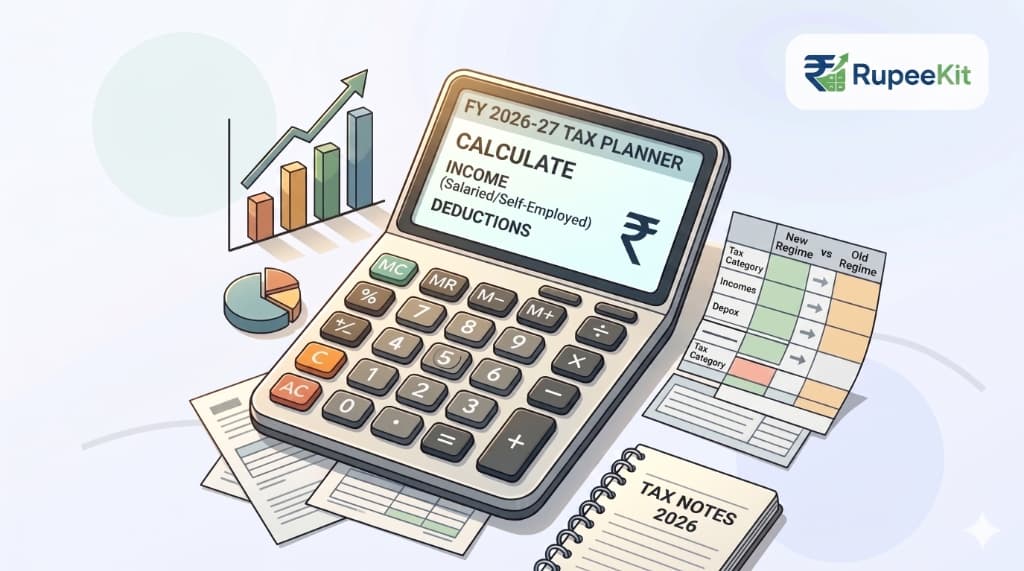
Income Tax Calculator 2026 India | RupeeKit
Use RupeeKit to understand old vs new regime differences, estimate future income impact, and plan with clearer assumptions.
May 2026Read Article →
Income Tax9 min read
Old vs New Tax Regime: Which Saves More Tax? Worked Examples from Rs 7L to Rs 20L
Every salaried taxpayer in India faces the same choice each year: stay with the default new tax regime, or opt for the old regime and claim deductions like HRA, 80C and home loan interest. The right answer is not the same for everyone — it depends almost entirely on how much you can legitimately claim as deductions. This guide walks through worked comparisons at five salary levels, computed with RupeeKit's calculator engine, and gives you a practical break-even rule you can apply to your own payslip.
July 2026Read Article →
Loans & Debt7 min read
Home Loan vs Rent in India: Which Is the Smarter Financial Choice?
The rent-vs-buy debate is one of the most emotionally charged financial decisions Indians face. Owning a home is tied to financial security and social status, yet renting can leave more money in your pocket each month. The truth is neither option is universally better — the right answer depends on your city, income stability, investment discipline, and how long you plan to stay.
July 2026Read Article →
Income Tax8 min read
How to Save Capital Gains Tax on Equity and Mutual Funds in India (AY 2026-27)
Budget 2024 reshuffled the capital gains tax structure for equity investors in India, and the changes remain for AY 2026-27. If you sold equity shares, equity mutual funds, or ETFs at a profit during the financial year, you owe tax — and the rate depends on how long you held the investment. Understanding the two rates, the Rs 1.25 lakh exemption, and legal strategies to reduce your bill can save thousands every year.
July 2026Read Article →
Income Tax7 min read
PPF vs ELSS vs FD — Which Section 80C Investment Gives the Best Returns in India?
Section 80C lets you reduce your taxable income by up to Rs 1,50,000 per year — and three investment options dominate the conversation: PPF, ELSS mutual funds, and tax-saving fixed deposits. Each occupies a different point on the risk-return-liquidity spectrum. The right choice depends on your income level, tax bracket, investment horizon, and how much risk you can stomach. This guide compares all three in detail with post-tax return examples.
July 2026Read Article →
Investing8 min read
Zerodha vs Upstox vs Angel One 2026: Which Broker May Suit You?
Choosing a broker is easier when you separate pricing from platform preferences. This comparison uses broker pricing and support pages verified on 3 September 2026, then matches the differences to common use cases such as buy-and-hold investing, active trading, research tools and NRI onboarding. There is no universal winner, and commercial relationships do not determine the comparison order.
September 2026Read Article →
Investing9 min read
Mutual Funds for Beginners India 2026: How to Start Investing
Mutual funds are the easiest way for most Indians to invest in the stock market without picking individual stocks. This guide covers everything a first-time investor needs to know — what mutual funds are, the main types, how SIPs work, what expense ratio and NAV mean, and the simplest way to start investing today.
July 2026Read Article →
Income Tax8 min read
New Tax Regime vs Old Tax Regime FY 2026-27: Which Is Better for You?
The Budget 2025 overhauled the new tax regime — raising the nil-tax threshold to Rs 12 lakh (effectively zero tax under the new regime for income up to Rs 12.75 lakh including standard deduction). This makes the regime comparison more important than ever. Here is everything you need to know about both regimes and how to decide which one saves you more tax in FY 2026-27.
July 2026Read Article →
Loans & Debt6 min read
Home Loan Eligibility by Monthly Salary in India 2026: Complete Guide
Home loan eligibility in India is primarily determined by your net monthly salary and the bank's Fixed Obligation to Income Ratio (FOIR). Most banks set a 50% FOIR limit, meaning your total monthly EMIs (including the new home loan) cannot exceed half your take-home pay. This guide gives you a ready-reckoner table across salary ranges, plus the key factors that change the final number.
July 2026Read Article →
Income Tax6 min read
Income Tax on Rs 12 Lakh Salary: Zero Tax Under New Regime FY 2026-27
Under the new tax regime for FY 2026-27 (AY 2027-28), eligible normal slab-rate income up to Rs 12 lakh can become tax-free through the Section 87A rebate. For salaried employees, the Rs 75,000 standard deduction can extend this zero-tax point to Rs 12.75 lakh of gross salary. This guide explains the calculation and the marginal relief that prevents a disproportionate tax jump when taxable income moves slightly above Rs 12 lakh.
August 2026Read Article →
Salary & Benefits7 min read
How to Calculate In-Hand Salary from CTC in India 2026
CTC (Cost to Company) and take-home (in-hand) salary are very different numbers. A Rs 15 lakh CTC offer typically translates to Rs 80,000–90,000 per month in hand — not Rs 1.25 lakh as many candidates assume. Understanding the gap helps you negotiate better and plan more accurately. This guide breaks down every deduction, with real worked examples across CTC ranges.
July 2026Read Article →
Savings & Retirement7 min read
How to Withdraw EPF After Resignation in India 2026: Step-by-Step Online Guide
After resigning, you can withdraw your full EPF balance — but not right away. You need to wait 2 months from your last working day, and then file the claim online using your UAN. The whole thing is paperless if your KYC is already linked. Here is the step-by-step process, what documents you will need, and when the withdrawal becomes taxable.
July 2026Read Article →
Savings & Retirement6 min read
EPF Partial Withdrawal Rules India 2026: Housing, Medical, Education & More
The EPFO allows members to make partial withdrawals (called "advances") from their EPF account for specific purposes without resigning from their job. These are not loans — the amount is deducted from your EPF balance and does not need to be repaid. The six main purposes are housing, medical, education, marriage, pre-retirement, and natural calamity. Each has different eligibility criteria, waiting period, and withdrawal limits.
July 2026Read Article →
Salary & Benefits6 min read
New Gratuity Rules 2026: 1-Year vs 5-Year Rule Explained
India made the four Labour Codes effective from 21 November 2025. Under the Code on Social Security, 2020, an employee engaged under a genuine fixed-term employment contract becomes eligible for gratuity after one year of service under that contract. The general five-year continuous-service condition continues for employees who do not fall within an exception. Here is what the current rule means and who it affects.
August 2026Read Article →
Budgeting & Money Planning7 min read
How to Improve CIBIL Score from 650 to 750 in India 2026: Actionable Guide
A CIBIL score of 650 sits in the "fair" range — it is enough to get credit in some cases, but lenders will either reject your application or charge you a significantly higher interest rate. Moving from 650 to 750 can take 6–18 months with consistent action, and can save you lakhs in lower interest on home loans, personal loans, and credit cards. Here is exactly what to do, in priority order.
July 2026Read Article →
Need Interactive Estimations?
Our articles explain the rules, but you can compute exact outcomes for your income, EMIs, mutual funds, or tax deductions instantly.