FCRA 2.0 is the name commonly being used for India’s upgraded foreign-contribution compliance system. It is not a completely new Act. It combines the existing Foreign Contribution (Regulation) Act, the Foreign Contribution (Regulation) Amendment Rules, 2026, the new digital FCRA 2.0 portal, and a separate Amendment Bill that is still pending in Parliament. This guide explains what is already law, what is only proposed, and what organisations should do next.
FCRA 2.0 in one minute
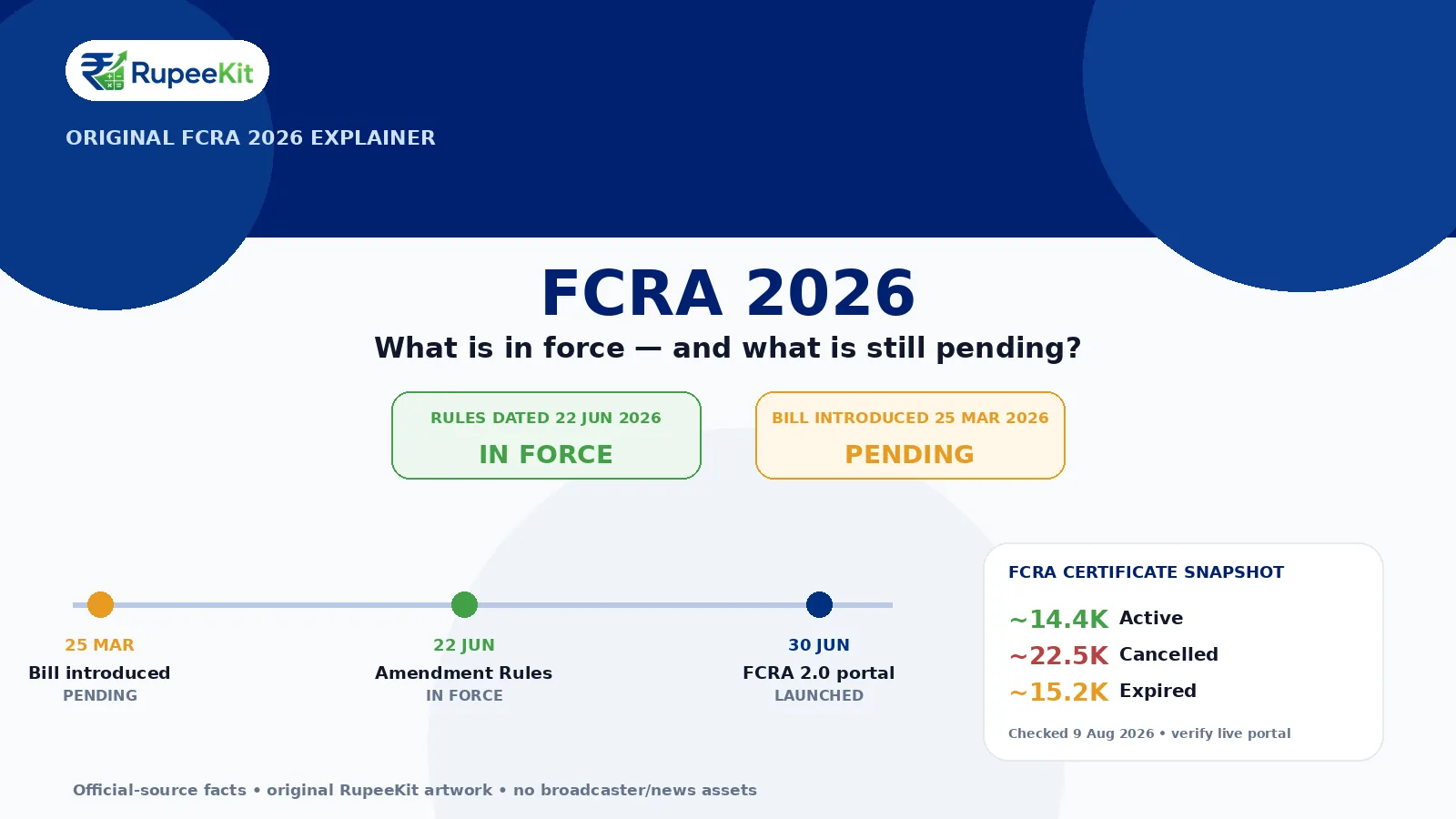
Quick AnswerWhat is FCRA 2.0 in India? FCRA 2.0 is the upgraded system for controlling and tracking foreign donations received in India. The 2026 Rules are already in force from 22 June 2026, and the new portal was launched on 30 June 2026. Registration is now tied to exact purposes and States or Union Territories, reporting is more detailed, and renewal generally requires at least Rs 10 lakh of foreign contribution to have been used in the previous two years. The Foreign Contribution (Regulation) Amendment Bill, 2026 has not been passed: as of 10 August 2026 it remains pending in Parliament, having been introduced in the Lok Sabha on 25 March 2026.
The Rules and portal are operational. Proposals contained only in the pending Bill should not be treated as enacted law.
Answer Engine Summary
FCRA 2.0 is not a replacement Act. It is the current FCRA framework after the Foreign Contribution (Regulation) Amendment Rules, 2026 and the launch of a redesigned online portal. The Rules are in force from 22 June 2026. They introduce purpose- and State-specific registration, Form FC-6F transition reporting for existing associations, a wider definition of key functionary, a minimum utilisation condition for renewal, and deeper donor and project reporting. The Foreign Contribution (Regulation) Amendment Bill, 2026 remains pending and must be discussed separately from rules that are already legally effective.
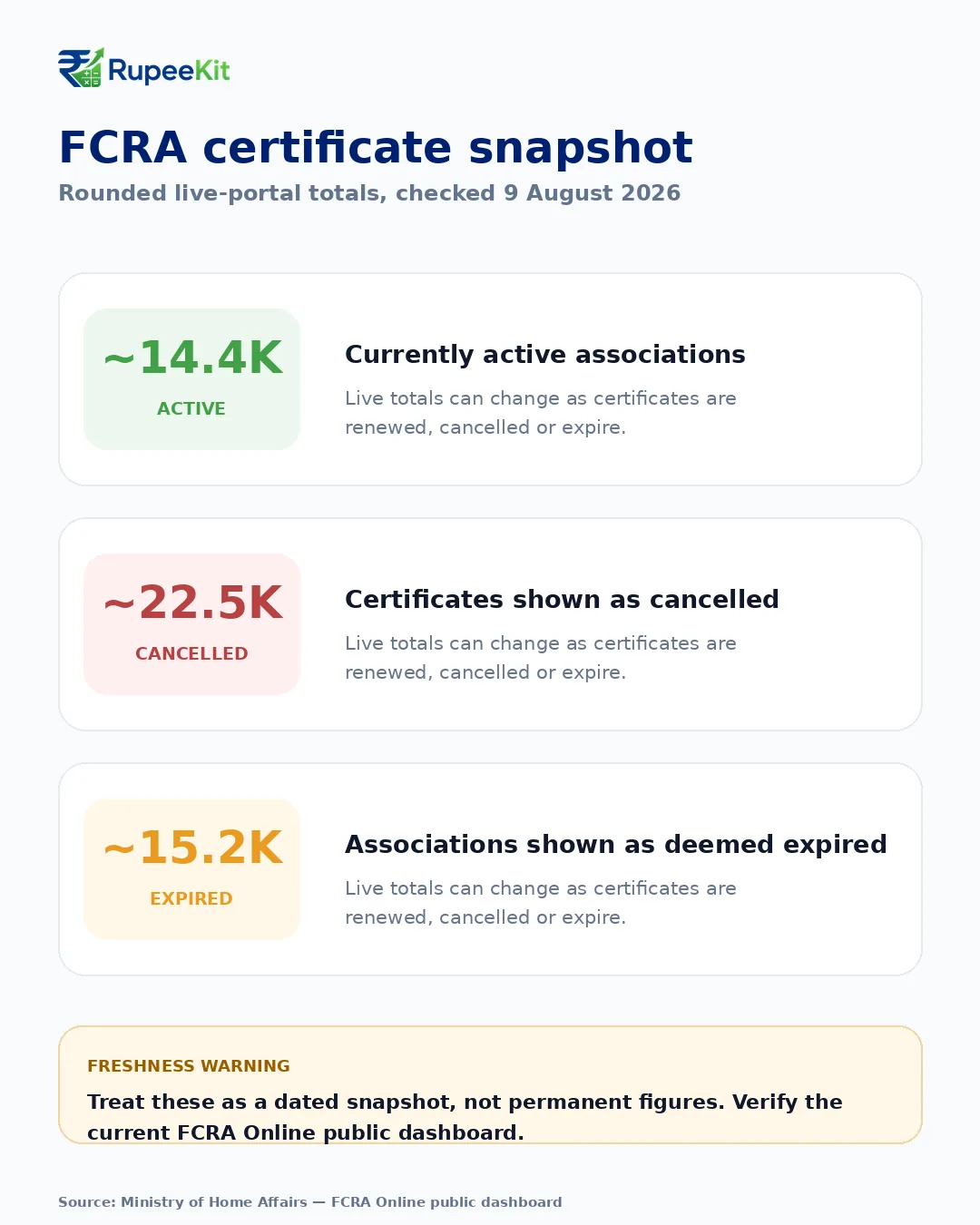
14,500 approx.
Active organisations
15,000–20,000
Applications per year
17,000 approx.
Annual returns per year
FCRA certificate status snapshot
Counts displayed by the official portal during research.
Ministry of Home Affairs · Government of India
FCRA Online
Foreign Hospitality
FC-2 applications
New Registration
FC-3A and FC-3B
Registered Associations
Renewal, FC-4 and FC-6
Has the FCRA Amendment Bill, 2026 been passed? (status as on 10 August 2026)
No. The Foreign Contribution (Regulation) Amendment Bill, 2026 has not been passed by either House of Parliament. It was introduced in the Lok Sabha on 25 March 2026 and, as on 10 August 2026, it is still pending.
The Bill has been reported as listed for discussion during the ongoing Monsoon session, which is scheduled to conclude on 13 August 2026. Reports about the exact date of the debate have differed, so the listing should be treated as indicative rather than settled. Because this status can change within days, verify it against the Lok Sabha bill list or the PRS bill track before relying on it.
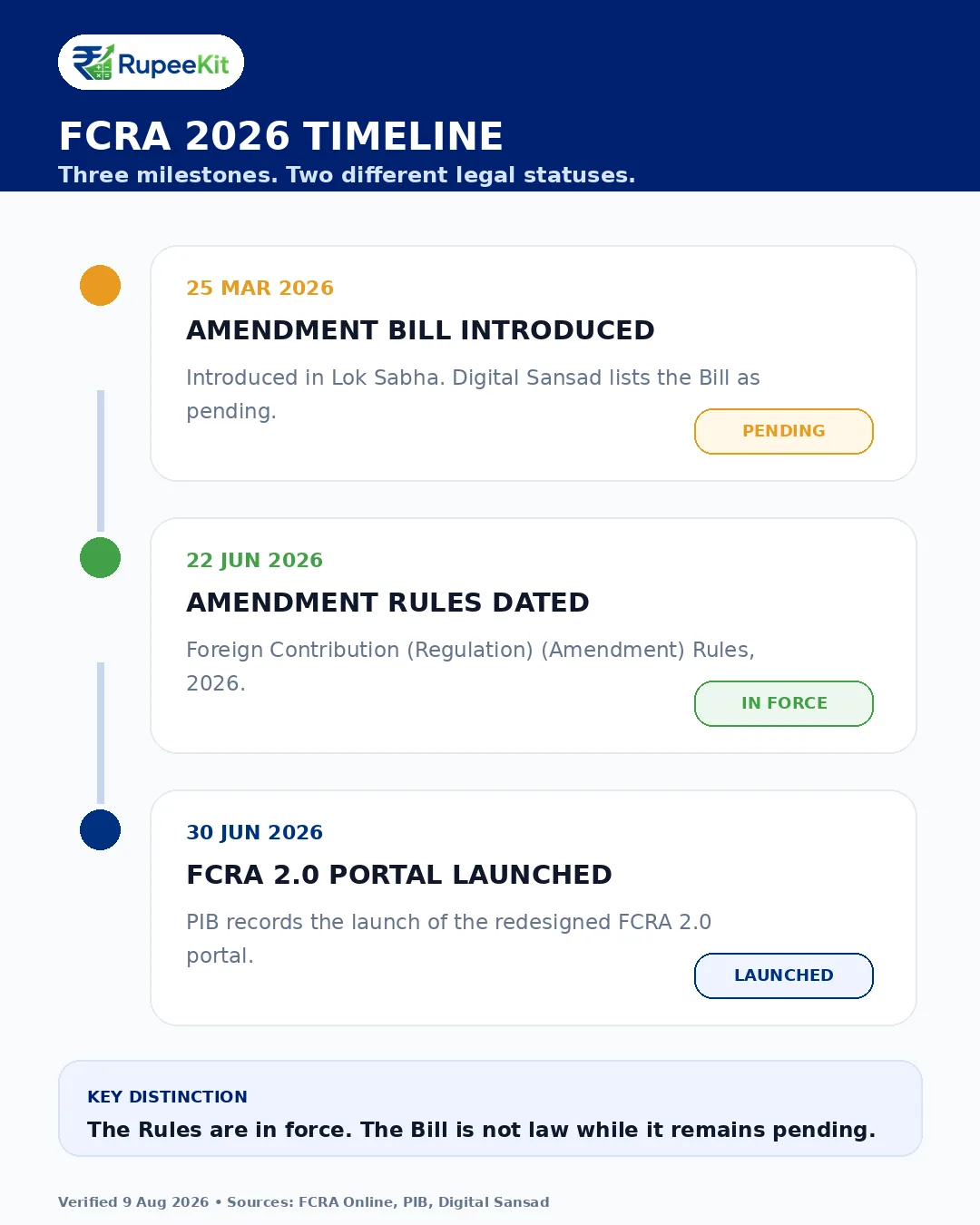
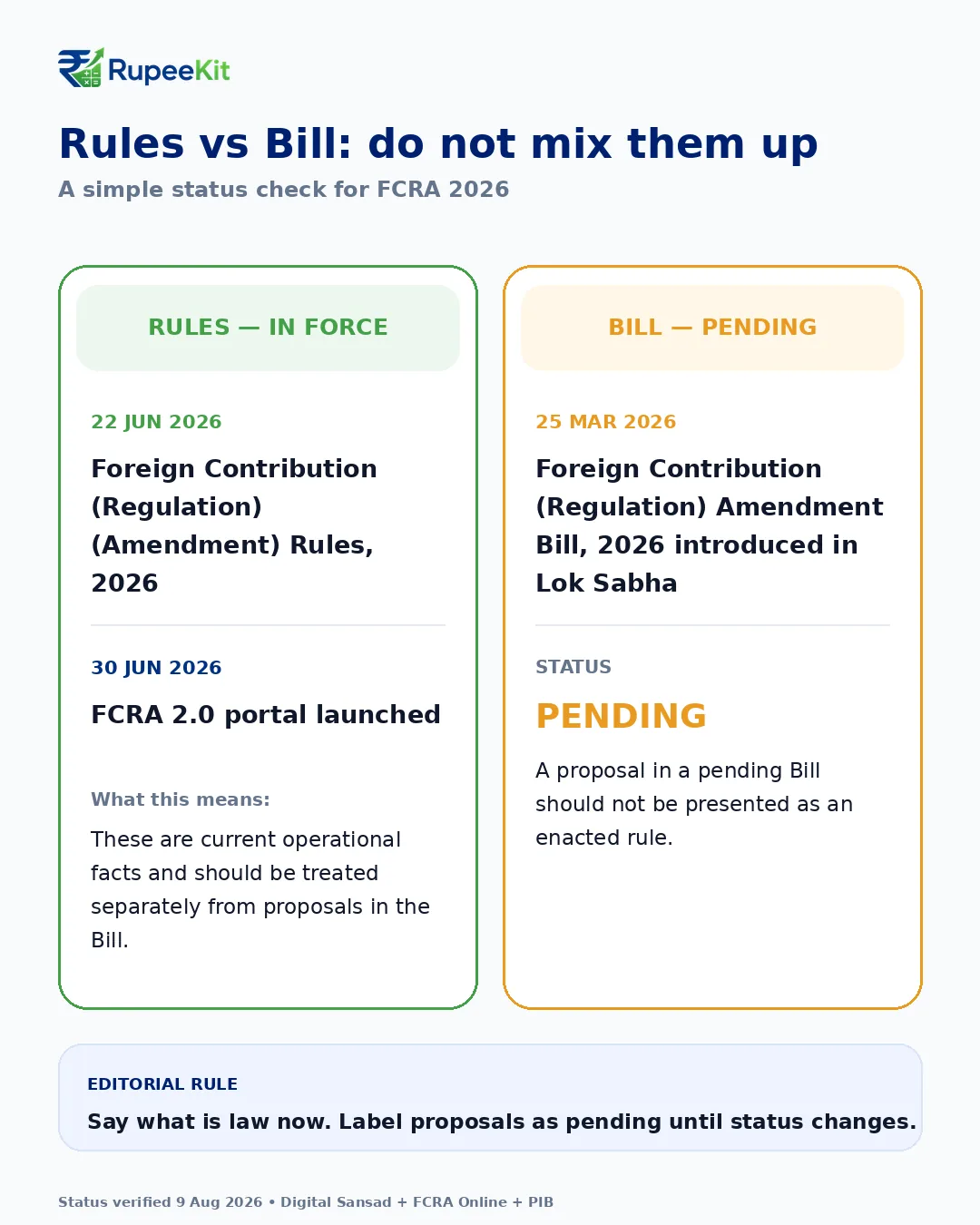
This distinction matters in practice. The Foreign Contribution (Regulation) Amendment Rules, 2026 are already in force from 22 June 2026 and must be complied with now. The Bill is a separate proposal, and anything that appears only in the Bill — including the Designated Authority for foreign-funded assets — is not yet law.
In force now: FCRA Act, 2010; FCRA Amendment Act, 2020; FCRA Amendment Rules, 2026 (from 22 June 2026); the FCRA 2.0 portal (from 30 June 2026). Not law yet: the Foreign Contribution (Regulation) Amendment Bill, 2026, pending in Parliament as on 10 August 2026.
FCRA बिल क्या है? (हिंदी में संक्षिप्त जानकारी)
FCRA का पूरा नाम Foreign Contribution (Regulation) Act है, यानी विदेशी अंशदान (विनियमन) अधिनियम। यह कानून तय करता है कि भारत में कौन से व्यक्ति और संस्थाएँ विदेश से चंदा, अनुदान या सहायता ले सकती हैं और उस पैसे का उपयोग किस तरह किया जा सकता है। इसे गृह मंत्रालय लागू करता है।
क्या FCRA बिल पास हो गया है? नहीं। विदेशी अंशदान (विनियमन) संशोधन विधेयक, 2026 को 25 मार्च 2026 को लोक सभा में पेश किया गया था, लेकिन 10 अगस्त 2026 तक यह संसद में लंबित है और किसी भी सदन से पारित नहीं हुआ है।
ध्यान देने योग्य बात यह है कि FCRA संशोधन नियम, 2026 पहले से लागू हैं — ये 22 जून 2026 से प्रभावी हैं और नया FCRA 2.0 पोर्टल 30 जून 2026 को शुरू हुआ था। इसलिए जो प्रावधान सिर्फ़ विधेयक में हैं, उन्हें अभी कानून नहीं माना जाना चाहिए। नवीनतम स्थिति के लिए गृह मंत्रालय के आधिकारिक FCRA पोर्टल की जाँच करें।
What FCRA means in very simple words
FCRA stands for the Foreign Contribution (Regulation) Act. It controls how certain people and organisations in India may receive and use donations, grants, securities or valuable articles coming from a foreign source. The Ministry of Home Affairs administers the law.
The government wants a traceable answer to four basic questions: who sent the foreign money, who finally controls the donor, why the money came to India, and where and how it was spent. FCRA creates the registration, banking, accounting and reporting system for those answers.
A normal payment from a foreign customer to an Indian business for genuine goods or services is generally a commercial receipt governed by other laws. A grant or donation from a foreign source for cultural, economic, educational, religious or social work may fall within FCRA. The real nature of the transaction matters more than the label used by the sender.
A foreign foundation gives an Indian trust Rs 50 lakh for a child-nutrition programme: this is normally foreign contribution. A foreign customer pays an Indian software company for a completed software project: that is normally business income, not a charitable foreign donation merely because the customer is located abroad.
FCRA 2.0 is not one new law
The expression “FCRA 2.0” can be confusing because it covers several different things. The base law is still the Foreign Contribution (Regulation) Act, 2010, as amended over time. The Foreign Contribution (Regulation) Amendment Rules, 2026 were notified on 22 June 2026 and are already in force. The redesigned FCRA 2.0 portal was launched on 30 June 2026.
A separate Foreign Contribution (Regulation) Amendment Bill, 2026 was introduced in the Lok Sabha on 25 March 2026. As on 10 August 2026, it has not been passed and is pending in Parliament. Therefore, a proposal appearing only in that Bill is not the same as an operative rule.
- FCRA Act, 2010: in force
- FCRA Amendment Act, 2020: in force
- FCRA Amendment Rules, 2026: in force from 22 June 2026
- FCRA 2.0 portal: launched on 30 June 2026
- FCRA Amendment Bill, 2026: pending in Parliament as of 5 August 2026
Portal application fees
Who usually needs FCRA registration or prior permission?
FCRA can apply to an Indian NGO, charitable trust, registered society, Section 8 company, educational institution, hospital, research body, religious organisation or another person carrying out a definite cultural, economic, educational, religious or social programme.
An established organisation that expects to receive foreign contribution regularly normally applies for FCRA registration. The official framework describes registration as generally available to organisations that have been operational for at least three years and can show a genuine track record.
A newer organisation or an organisation receiving one defined grant may use the prior-permission route. Prior permission is tied to a specified donor, amount and project; it is not a general licence to accept foreign donations from anyone.
A new water-conservation trust wants Rs 25 lakh from one named UK foundation for a specific project in two districts. It may apply for prior permission for that donor and project instead of treating the permission as open approval for every future foreign donation.
Core rules that organisations must already follow
All foreign contribution must first enter the designated FCRA account at the State Bank of India, New Delhi Main Branch. The organisation may then use permitted utilisation accounts, but the initial receipt must pass through the designated entry point so that there is one auditable trail.
The 2020 changes generally prohibit an FCRA recipient from transferring foreign contribution to another person or NGO as a sub-grant. A genuine purchase of goods or services is different, but organisations should not disguise a grant as a false vendor payment.
Administrative expenses are generally capped at 20% of the foreign contribution received in a financial year unless prior approval is obtained. Registration is valid for five years and must be renewed. Annual returns are filed online in Form FC-4 with audited receipt and utilisation details.
- Receive foreign contribution first in the designated SBI New Delhi Main Branch FCRA account
- Use money only for the approved purpose
- Do not pass foreign contribution to another NGO as a sub-grant
- Keep administrative expenses within the permitted limit
- Maintain separate books, bank records, donor records and supporting documents
- File the annual return and renew the registration on time
Big 2026 change: registration is purpose-specific and State-specific
Under the 2026 Rules, the registration certificate must identify the exact purpose or purposes for which approval is granted and the States or Union Territories where the activities will be carried out. Purposes must be selected from the Schedule attached to the Rules rather than being described only through a very broad label.
Existing registered associations must, within one year from commencement of the Rules, submit an intimation in Form FC-6F specifying the purposes and States or Union Territories for which they want to retain registration.
The application fee covers one purpose and one State or Union Territory. The Rules provide an additional fee of Rs 300 for each additional State or Union Territory and Rs 300 for each additional purpose.
An organisation approved for maternal healthcare in West Bengal and Odisha should not assume that the same foreign funds can immediately be used for an unrelated education campaign in Maharashtra. It should first check whether its approved purposes and geographical coverage allow that activity and seek the required change where necessary.
Wider meaning of key functionary
The 2026 Rules define “key functionary” broadly. Depending on the organisation, this may include a company director, firm partner, trustee, Karta of a Hindu undivided family, office-bearer, governing-body or managing-committee member, or another person who controls or is responsible for management and affairs.
This matters because identity, eligibility and disclosure requirements are no longer limited to one chief functionary or accountant. Trustees, directors and people exercising real control should understand the organisation’s FCRA approvals, donor trail, bank accounts and reporting system.
The Rules also clarify that an association having foreign nationals, other than persons of Indian origin, as key functionaries will ordinarily not be considered eligible for registration or prior permission, subject to cases, circumstances and conditions that the Central Government may specify.
Renewal now includes a minimum-utilisation test
For renewal, the 2026 framework generally requires an organisation to demonstrate that it utilised at least Rs 10 lakh of foreign contribution during the preceding two years. The stated purpose is to keep live registrations with organisations that are actually active rather than dormant entities holding approval without carrying out declared work.
This rule can affect small organisations, organisations with irregular grants and organisations whose projects were delayed. They should review the exact renewal conditions and official portal instructions well before the certificate expires instead of waiting until the last month.
An association has a valid certificate but used only Rs 3 lakh of foreign contribution in the previous two years. It should not assume that renewal will be automatic. The minimum-utilisation rule and any applicable exception or official clarification must be checked before filing.
Annual reporting is becoming much more detailed
The 2026 Rules move reporting from a broad annual number toward project-level and activity-level disclosure. Organisations may need to show which project used the funds, what activity was performed, and in which approved geographical area the work occurred.
Reporting now includes disclosure of the organisation’s website and social-media presence, along with fuller details of key functionaries. Public statements, project pages and social posts should therefore be consistent with the purposes and activities declared to the government.
Where money passes through an overseas intermediary, aggregator or foundation, the organisation must identify the ultimate foreign donor. Reporting only the final payment platform may not be enough when another person or entity is the real source behind the contribution.
Money moves from an original donor to an international fundraising platform, then to a foreign foundation and finally to an Indian NGO. The NGO should preserve records identifying the original source, intermediary chain, donor agreement and bank references instead of recording only the platform name.
Religious and faith-based activities under the 2026 Rules
The Schedule gives more detail about religious purposes that may be considered, including maintenance of places of worship, religious education, moral instruction, meditation programmes and preservation of faith traditions. Faith-based welfare is not automatically prohibited merely because an organisation is religious.
The Rules exclude proselytisation from permitted religious activity. In simple terms, foreign contribution should not be used for an activity directed at inducing or promoting religious conversion. Organisations should define project objectives, beneficiary selection and spending records clearly enough to show the actual welfare or permitted religious purpose.
Because facts and implementation can be sensitive, a faith-based organisation should obtain case-specific professional advice before launching a new foreign-funded programme that could be interpreted in more than one way.
What the FCRA 2.0 portal changes
The redesigned portal makes major processes such as applications, renewals, annual returns and other services end-to-end digital. According to the Ministry of Home Affairs, physical document submission is being removed, reducing paperwork for compliant organisations.
The portal includes Aadhaar-based authentication, e-Sign, OCR-based document analysis and a login-based dashboard. It is integrated with databases and systems such as PAN, Aadhaar, OCI, NGO Darpan, banks and the Institute of Chartered Accountants of India’s UDIN system.
These integrations may make verification faster, but they also make inconsistencies easier to identify. Names, PAN details, office-bearers, bank accounts, audited figures, donor records and declarations should match across systems.
- Fully digital applications, renewals and annual returns
- Aadhaar authentication and e-Sign
- OCR-assisted document analysis
- Integrated organisation dashboard
- Connections with PAN, Aadhaar, OCI, NGO Darpan, banks and UDIN
- Planned future features include an AI chatbot and mobile access
Ministry of Home Affairs · Government of India
FCRA Online
Login to your Account
User ID (PAN / Existing User ID)
Password
Enter CAPTCHA
Don't have an account? Sign Up
Login-to-filing walkthrough
- 1
Choose the service
Use New Registration for FC-3A or FC-3B. Existing associations use Registered Associations for renewal, FC-4 annual returns and FC-6 changes.
- 2
Sign up or log in
New users select Sign Up. Existing users enter PAN or their user ID, password and CAPTCHA.
- 3
Prepare organisation records
Keep PAN, NGO Darpan ID, registration papers, governing-body details and key-functionary records ready.
- 4
Select purpose and location
Choose the exact purpose and every State or Union Territory where the foreign-funded activity will happen.
- 5
Add the SBI FCRA account
Foreign contribution must first enter the designated SBI New Delhi Main Branch FCRA account.
- 6
Upload and verify documents
Check OCR-extracted data, complete required authentication, pay the applicable fee and e-sign.
- 7
Submit and track
Save the acknowledgement and application reference number, then use Track Application for status and clarifications.
Practical FCRA 2.0 compliance checklist
The best response to FCRA 2.0 is not panic; it is better record-keeping and earlier review. The governing body should receive a simple compliance dashboard instead of leaving the entire subject to one accountant.
- Confirm the certificate validity date and start renewal preparation early
- Match every project to an approved purpose and approved State or Union Territory
- Prepare and submit Form FC-6F within the applicable transition period
- Verify every trustee, director, office-bearer and person exercising real control
- Identify the original and ultimate donor, including intermediary platforms
- Reconcile the SBI FCRA account, utilisation accounts and books every month
- Track administrative expenses against the 20% limit
- Do not make prohibited sub-grants to another NGO
- Keep project-wise invoices, contracts, beneficiary records and activity evidence
- Make website and social-media descriptions consistent with declared activities
- Maintain an asset register showing whether each asset used foreign, domestic or mixed funding
- Check whether the Rs 10 lakh two-year utilisation condition may affect renewal
- File Form FC-4 and all change intimations within the official deadlines
Common mistakes that create serious risk
Many FCRA problems begin with basic operational errors rather than an obviously unlawful project. A late renewal, wrong bank account, unreported governing-body change or mismatch between the donor agreement and actual project can become difficult to explain later.
- Receiving foreign contribution before registration or prior permission is valid
- Receiving the money in a non-designated account
- Using the funds for an unapproved purpose or outside the approved geography
- Treating a sub-grant as a fake consulting or vendor payment
- Failing to identify the real donor behind an aggregator
- Mixing foreign contribution with domestic donations or business income
- Exceeding the administrative-expense limit without approval
- Missing annual-return, renewal or change-intimation deadlines
- Keeping outdated trustee, director, address or bank details on the portal
- Using foreign-funded assets without a source-wise asset register
Balanced view: why the changes are debated
The government’s position is that more precise approvals, donor tracing and digital integration improve transparency, protect national interest and make the system easier for honest organisations while strengthening enforcement against misuse.
Civil-society organisations and legal commentators may worry that purpose- and geography-specific approvals, detailed monitoring and consequences connected with registration can create a heavy burden, especially for small organisations or groups working on sensitive issues.
The correct practical approach is to separate political debate from legal status. Organisations must comply with the Rules that are already in force, monitor the pending Bill, and document any genuine implementation difficulty through professional representations and lawful remedies.
Final takeaway
FCRA 2.0 changes the compliance question from “Do you broadly work in the social sector?” to “Who exactly funded this project, what precise approved activity was performed, in which approved State or Union Territory, through which bank trail, and what evidence proves the spending?”
For a well-run organisation, the solution is a clean donor trail, purpose-wise budgeting, State-wise project mapping, board-level oversight, timely portal filings and an asset register. Because the law is specialised and continues to evolve, important decisions should be checked with an FCRA-experienced lawyer or chartered accountant and verified against the latest Ministry of Home Affairs material.
Frequently Asked Questions
Has the FCRA Bill been passed or not?
Not passed. The Foreign Contribution (Regulation) Amendment Bill, 2026 was introduced in the Lok Sabha on 25 March 2026 and, as on 10 August 2026, it is still pending in Parliament and has not been cleared by either House. It has been reported as listed for discussion in the Monsoon session ending 13 August 2026, but the position can change quickly, so confirm on the official Lok Sabha or PRS bill track.
Is the FCRA Bill 2026 passed in Parliament today?
No. As on 10 August 2026 no House of Parliament has passed the FCRA Amendment Bill, 2026. What is already legally in force is a different instrument: the FCRA Amendment Rules, 2026, effective from 22 June 2026.
क्या FCRA बिल पास हो गया है?
नहीं। विदेशी अंशदान (विनियमन) संशोधन विधेयक, 2026 अभी संसद में लंबित है। इसे 25 मार्च 2026 को लोक सभा में पेश किया गया था, और 10 अगस्त 2026 तक यह किसी भी सदन से पारित नहीं हुआ है। हालाँकि FCRA संशोधन नियम, 2026 पहले से 22 जून 2026 से लागू हैं। ताज़ा स्थिति आधिकारिक स्रोत पर ज़रूर जाँचें।
FCRA बिल क्या है?
FCRA यानी Foreign Contribution (Regulation) Act, भारत में विदेशी चंदे और अनुदान को नियंत्रित करने वाला कानून है। FCRA संशोधन विधेयक, 2026 इसमें बदलाव का प्रस्ताव है, जिसमें उन संस्थाओं की विदेशी-वित्तपोषित संपत्तियों के प्रबंधन के लिए एक निर्दिष्ट प्राधिकरण (Designated Authority) बनाने का प्रस्ताव शामिल है जिनका FCRA पंजीकरण समाप्त हो जाता है। यह विधेयक अभी कानून नहीं बना है।
Is FCRA 2.0 a completely new Act?
No. FCRA 2.0 is a common name for the upgraded compliance framework built on the FCRA Act, 2010, the Amendment Rules, 2026 and the redesigned portal. A separate Amendment Bill, 2026 is pending in Parliament.
When did the FCRA Amendment Rules, 2026 take effect?
The Rules were notified and came into force on 22 June 2026.
When was the FCRA 2.0 portal launched?
The Ministry of Home Affairs launched the FCRA 2.0 portal on 30 June 2026.
Is the FCRA Amendment Bill, 2026 already law?
No. As on 10 August 2026, it remains pending in Parliament and has not been passed. Proposals in the Bill should be kept separate from the 2026 Rules that are already in force.
What is the minimum foreign-contribution utilisation required for renewal?
The 2026 framework generally requires at least Rs 10 lakh of foreign contribution to have been utilised during the preceding two years for renewal. Organisations should check current official instructions and any applicable exception before filing.
What is Form FC-6F?
Form FC-6F is the transition intimation through which an association registered before the 2026 Rules specifies the purposes and States or Union Territories for which it seeks to retain registration.
Can one NGO transfer foreign contribution to another NGO?
The post-2020 framework generally prohibits transfer of foreign contribution to another person or NGO as a sub-grant. Genuine purchases of goods or services must be real, properly documented and not used to disguise a grant.
Can an NGO spend foreign contribution in any State in India?
Under the 2026 Rules, registration is tied to specified States or Union Territories. An organisation should use funds only within its approved purpose and geographical scope or obtain the required modification.
What is an ultimate foreign donor?
It is the original person or entity that is the real source of the foreign contribution, even when money reaches the Indian organisation through an overseas platform, aggregator, foundation or other intermediary.
Can foreign contribution be used for religious work?
Certain listed religious and faith-based activities may be permitted, such as maintenance of places of worship, religious education, moral instruction and meditation. Proselytisation is excluded from permitted religious activity under the 2026 Rules.
What happens to foreign-funded assets if registration ends?
The current Act already contains vesting provisions in specified cases. The pending 2026 Bill proposes a more detailed Designated Authority system for provisional and, later, permanent vesting. The final legal position will depend on the Bill passed by Parliament and the rules made under it.
Where should an organisation verify the latest FCRA requirements?
Use the official Ministry of Home Affairs FCRA portal, Gazette notifications and official PIB material. For a specific organisation or transaction, obtain advice from an FCRA-experienced lawyer or chartered accountant.
Source, Methodology & Educational Disclaimer
RupeeKit explains personal-finance topics using the assumptions, examples, calculator logic, and cited sources shown on the page. Where a topic depends on tax, regulatory, government, lender, or product rules, readers should verify the latest position with the relevant official source before acting.
The content on this page is provided for general informational and educational purposes only. It does not constitute personalized financial, tax, legal, investment, or loan advice. RupeeKit does not guarantee returns, tax savings, rankings, or loan approval.